How Much Do Online Poker Players Actually Make? 2026 Earnings Guide

Key facts:
- A winning player at NL50 with 4 bb/100 makes €300-500/month gross (excluding rakeback) playing 20,000 hands
- Rakeback adds 20-50% extra depending on the room (€80-250/month additional in that example)
- Variance can cause entire months in the red even with confirmed positive winrate over 100k+ hands
- Making a living from poker requires minimum 30-50 buy-in cushion and facing downswings of 20-30% of bankroll
- Real costs (HUD software €50-100/month, training €100-500/month, taxes 19-47%) reduce net profits by 30-40%
The question everyone asks when starting: how much do you actually make playing online poker? The short answer: it depends on your skill level, your volume, and how much variance you're willing to handle. The long answer includes concrete numbers, real scenarios, and far less glamour than some people sell.
In 2026, online poker remains profitable for players with solid strategy, but expectations need adjusting. The global market reached $120.67 billion USD in 2025 and projects $238.84 billion by 2033, demonstrating growing opportunities. However, the competition is tougher than ever and the average recreational player loses money in the long run.
Your gross winnings are one thing, your net profits after rake, software, training and taxes are something entirely different. This article breaks down the real figures based on your level and dedication.
The Real Formula: How to Calculate Your Net Winnings
Before talking about how much you make, you need to know how to calculate it correctly. Many players think they're winning when they're actually losing because they don't account for all the moving parts.
Exact net profit formula:
(Final balance - Starting balance) - Total deposits + Total withdrawals = Actual net profit
Practical example: You start the year with €0 in the room, deposit €3,000 throughout the year, withdraw €4,200 and finish with €500 in your account. Your actual net profit is:
(500 - 0) - 3,000 + 4,200 = €1,700 net
This is the number that matters. Not what appears in your lobby. Not your "monthly winnings." The net profit you actually pocket after all deposits and withdrawals.
Important: If you play across multiple rooms (PokerStars + Winamax + PartyPoker.com, for example), you need to sum the net profits from each one separately. One player documented €23,864 annually combining two main rooms in 2025.
In tournaments, the calculation is more straightforward: prizes won minus all buy-ins paid (including rake). If you play a €100+€10 tournament and win €500, your real profit is €390 (500 - 100 - 10), not €500.
Serious rooms provide tax certificates with all this data broken down. Use them. They're your only way to know if you're actually winning or living off temporary variance.
How Much You Make Playing Online Poker: Real Figures by Stakes and Dedication
The answer to how much you make playing online poker depends on three main factors: your stakes, your winrate, and your monthly volume. A recreational player at microstakes can make €100-300/month net working 15-20 hours weekly. A professional at mid-stakes reaches €1,000-2,500/month, but with 40+ hours weekly and years of experience.
Earnings also depend on which format you choose. Cash games offer stability, tournaments offer big prizes with high variance, and Sit&Gos are somewhere in between.
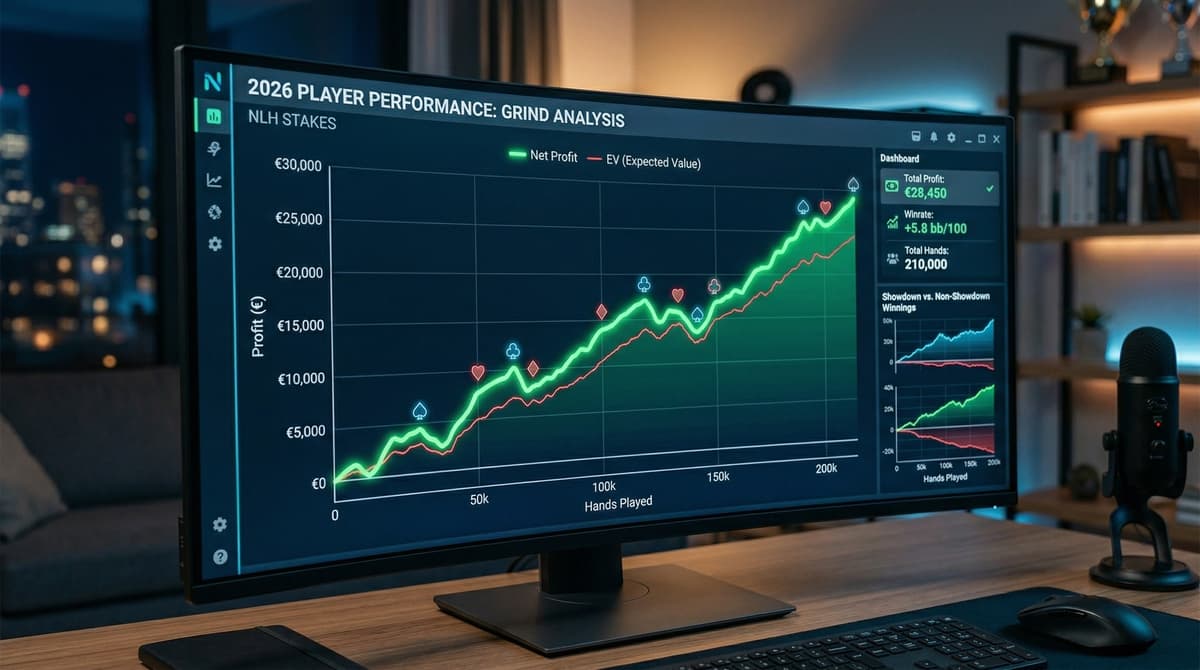
Online poker earnings graph 2026. Monitor with performance analysis: €28,450 profit and 210k hands played.
Key Factors That Determine How Much You Actually Make
Your success in online poker depends on concrete variables you can measure and optimize. It's not about luck or innate talent, but verifiable numbers that determine whether you make or lose money month after month.
1. Winrate: The Metric That Doesn't Lie
Your online poker winrate in bb/100 (big blinds won per 100 hands) is the fundamental metric. A player with 5 bb/100 at NL50 makes €2.50 every 100 hands. Sounds small, but with volume it adds up.
Realistic winrates by level in 2026:
- •NL10 (€0.05/€0.10): 5-8 bb/100 for consistent winners
- •NL25 (€0.10/€0.25): 4-6 bb/100
- •NL50 (€0.25/€0.50): 3-5 bb/100
- •NL100 (€0.50/€1): 2-4 bb/100
- •NL200+ (€1/€2): 2-3 bb/100 is already excellent
Why do winrates drop when moving up stakes? Because the competition is exponentially better. That NL200 reg studies with solvers, reviews every session, belongs to study groups and probably has 5+ years playing seriously.
Key fact: Your winrate is only reliable with samples of 50,000+ hands. Less than that is basically statistical noise mixed with variance.
2. Volume: The Critical Multiplier
A winrate of 5 bb/100 means nothing without volume. The difference between a recreational and a professional isn't just skill, it's how many hands they grind.
Typical monthly volumes:
- •Recreational: 5,000-10,000 hands (1-2 hours daily, single-tabling)
- •Semi-serious: 20,000-40,000 hands (10-15 hours weekly, 2-4 tables)
- •Part-time grinder: 50,000-80,000 hands (20-25 hours weekly, 4-6 tables)
- •Full-time professional: 100,000-200,000+ hands (40+ hours weekly, 8+ tables)
Multi-tabling is mandatory for serious volume, but there's a cost: your winrate drops when you add tables. A player with 6 bb/100 on 2 tables can drop to 4 bb/100 on 6 tables due to attention loss and tilt.
3. Format: Variance vs Stability
Cash games: More predictable income. You play, win/lose, stop when you want. Variance exists but is manageable with adequate bankroll. Rake impacts every hand (3-5% of pot with caps).
Tournaments (MTTs): Extremely high variance. You can play 100 tournaments without cashing anything and then score one big one that compensates everything. Average ROI for winners is 5-15% in low buy-in tournaments. A full-time grinder investing €50,000 annually can expect €5,000-20,000 net profit, but with brutal swings.
Sit & Go: Middle ground. Less variance than MTTs, more than cash. Moderate profitability but repetitive gameplay that can burn you out quickly.
4. Rakeback and Loyalty Programs
Here's the difference between being break-even and being a winner in many cases. Rake is the percentage the room retains from each pot (typically 3-5% with cap). Rooms return part of it via rakeback, points or rewards.
At PokerKing, BetKings and PartyPoker.com, typical rakeback ranges from 20% to 50% depending on your volume. A player generating €200 monthly rake can recover €40-100.
Additionally, PokerDealsAI offers AI Points calculated based on revenue generated (in USD), which accumulate independently of the room's base rakeback. These points represent an additional benefit that can significantly increase your total earnings.
For medium-high volume grinders, rakeback can represent 30-60% of total earnings. It's not optional, it's part of the business model.
Comparison Table: Real Earnings by Stakes in Cash Games (NL Hold'em 6-max)
Assuming 20,000 hands monthly, consistent winning player, not counting software/training costs:
| Stakes | Blinds | Estimated winrate | Gross profit/month | 30% Rakeback | Total before costs | Approx. hours |
|---|---|---|---|---|---|---|
| NL10 | €0.05/€0.10 | 6 bb/100 | €120 | €25 | €145 | 20-25h |
| NL25 | €0.10/€0.25 | 5 bb/100 | €250 | €50 | €300 | 20-25h |
| NL50 | €0.25/€0.50 | 4 bb/100 | €400 | €100 | €500 | 20-25h |
| NL100 | €0.50/€1 | 3 bb/100 | €600 | €150 | €750 | 20-25h |
| NL200 | €1/€2 | 2.5 bb/100 | €1,000 | €250 | €1,250 | 20-25h |
Now subtract the real costs:
- •HUD/Tracking software: €50-100/month (Holdem Manager, PokerTracker)
- •Ongoing training: €100-500/month (courses, coaching, subscriptions)
- •Taxes in Spain: 19% first €6,000, scaling up to 47% (capital gains in IRPF)
- •Operating expenses: Internet, adequate computer, ergonomic chair if it's your job
This clearly answers how much a professional poker player makes after all expenses: an NL100 player with €750/month before costs can end up with €400-500/month actual net. Still money, but not making a living from poker yet.
Format Comparison: Cash vs Tournaments vs Sit&Go
Each format has different economic characteristics that directly impact your monthly income and financial stability. The choice isn't just about gameplay preference, but how much variance you can handle psychologically and economically.
Cash Games: The Steady Job of Poker
Real advantages:
- •You know what you make each session (within normal variance)
- •Total schedule control: play when you want, stop when you want
- •Clearer bankroll management (30-50 buy-ins is sufficient)
- •You can multi-table effectively to multiply income
Disadvantages that hurt:
- •Rake eats directly from every pot you play
- •Downswings of 10-15 buy-ins are normal even playing well
- •Requires iron discipline not to play on tilt
- •Gameplay can become mechanical and boring
Realistic expectation: A winning player with 4 bb/100 at NL50 playing 25 hours weekly makes €400-600/month net after rakeback. Not spectacular, but consistent.
Tournaments: The Emotional Rollercoaster
Advantages:
- •Big prizes with small investment (winning a Sunday Million can change your year)
- •Maximum excitement: every tournament is a different story
- •Less rake exposure in percentage terms of the prize
- •You can play high stakes with moderate bankroll
Disadvantages:
- •Extreme variance: months without cashing anything is normal
- •Realistic ROI for good players: 5-15% in low buy-in tournaments
- •Impossible to predict monthly income
- •Requires 100-200 buy-in bankroll to absorb bad runs
Realistic expectation: A tournament grinder investing €3,000/month in buy-ins with 10% ROI makes €300/month on average, but distributed chaotically: €0-€0-€0-€0-€1,500-€0-€0-€2,100. Mentally exhausting.
Sit & Go: The Forgotten Middle Ground
Advantages:
- •Less variance than MTTs, more than cash
- •Predictable duration (30-60 minutes per tournament)
- •Good format to learn push/fold and ICM
- •Allows high volume with multi-tabling
Disadvantages:
- •Declining traffic in many rooms (people prefer MTTs or cash)
- •Lower ROI than big tournaments
- •Repetitive gameplay that can burn you out quickly
Realistic expectation: A decent player can achieve 3-7% ROI in €10-30 SnGs. With 50 tournaments daily (high volume), we're talking €200-400/month.
Variance and Downswings: What Nobody Wants to Hear
Here's the part that ruins most people's expectations. You can be a consistent winning player and have entire months in the red. It's not bad luck, it's mathematics.
Normal downswings by format:
- •Cash NL: 10-20 buy-ins below EV is statistically normal
- •MTTs: 100+ tournaments without cashing can happen to anyone
- •SnG: 30-50 tournaments in the red even with positive ROI
Warning: A player with 5 bb/100 confirmed over 100,000 hands has a 12% chance of losing money in any 10,000 hand sample. Variance is brutal.
Real downswing example:
Playing NL100 with confirmed 3.5 bb/100 winrate. In March 2026 I played 25,000 hands and finished -€850. Did I play badly? No. I reviewed every session, my strategy was correct. I simply ran into setups, bad beats and 60/40 situations that I lost 70% of the time. In April I recovered with +€1,200. That's how it works.
Bankroll management is not optional:
- •Cash games: Minimum 30 buy-ins, ideal 50
- •MTTs: 100-200 buy-ins if you're serious
- •Mix of formats: 40-60 buy-ins of the highest stake you play
Moving down in stakes when bankroll demands it isn't failure, it's professionalism. Moving up with 15 buy-ins because "I'm running good" is the perfect recipe for going bust.
How Much a Professional Poker Player Makes: Real Income in 2026
There's no universal figure because "professional" can mean anything from the NL50 grinder making €1,200/month to the high-roller moving €50k monthly. The question of how much a professional poker player makes varies enormously by level, dedication and experience.
Realistic professional profiles:
The Micro/Low Stakes Grinder
- •Main stakes: NL25-NL50, €5-20 MTTs
- •Volume: 80,000-120,000 hands/month in cash, or 300+ tournaments/month
- •Gross income: €800-1,800/month
- •Net after costs: €500-1,200/month
- •Situation: Makes a living from poker but tight, no luxuries
The Mid Stakes Reg
- •Main stakes: NL100-NL200, €20-100 MTTs
- •Volume: 60,000-100,000 hands/month (fewer tables, more attention)
- •Gross income: €2,500-5,000/month
- •Net after costs: €1,800-3,500/month
- •Situation: Comfortable life, can save, invests in serious training
The High Stakes Professional
- •Main stakes: NL500+, high rollers
- •Volume: Variable (fewer hands, more value per decision)
- •Income: €10,000-100,000+ annual net
- •Situation: Requires years of experience and €30k-100k+ bankroll
The reality: most poker "professionals" are in the first category, living month to month with income that a normal skilled job would exceed. Only a minority reaches truly high earnings.
Staking: Profitable in 2026?
Playing staked means someone (a "backer") covers your buy-ins in exchange for a percentage of your winnings, typically 20-50%. If you lose, the backer absorbs the loss.
When does it make sense?
- •Your ROI is >15-20% in tournaments
- •You don't have bankroll for your skill level
- •You want to play higher stakes without personal risk
- •You have demonstrable winrate but variance has left you without roll
When does it NOT make sense?
- •Your ROI is break-even or negative (nobody should stake you)
- •You have sufficient bankroll for your level
- •You don't like being accountable or sharing winnings
In 2026, staking remains profitable for both parties when there's trust and demonstrable results. But beware of abusive deals: 50% for the backer when you do all the work only makes sense if your bankroll is zero and your ROI is >20%.
Taxes in Spain: What the Tax Authority Expects in 2026
Online poker winnings are taxed as capital gains in IRPF. There was no change to a flat 50% (that December news was an April Fools' joke).
Current 2026 brackets:
- •Up to €6,000: 19%
- •€6,000-€50,000: 21%
- •€50,000-€200,000: 23%
- •Over €200,000: 26%
If you play regularly and it's your main income source, the Tax Authority may consider it economic activity, with different rates (up to 47% in high brackets).
Tax note: The tax information provided may vary according to your personal situation and legislative changes. It's recommended to consult with a qualified tax advisor for specific cases.
How to declare it correctly:
- 1.Request tax certificates from all rooms where you play
- 2.Calculate net winnings with the formula: (Final balance - initial) - Deposits + Withdrawals
- 3.Sum winnings from all rooms
- 4.Declare in Tax Return as capital gains
- 5.Keep all records in case of inspection
Important: Not declaring poker winnings is a mistake the Tax Authority detects easily. Rooms report large movements and financial institutions do too. Not worth the risk.
Hidden Costs That Destroy Your Margin
When calculating "how much I make," many people forget to subtract:
Mandatory software:
- •HUD/Tracker (Holdem Manager, PokerTracker): €50-100/month
- •Solver for study (PioSOLVER, GTO+): €100-500 one-time purchase or subscription
- •Hand analysis software: €20-50/month
Ongoing training:
- •Training site subscriptions: €50-200/month
- •Private coaching: €100-500/hour
- •Books, courses, study groups: €50-300/month
Operating:
- •Quality internet: €40-60/month
- •Powerful computer for multi-tabling: €800-2,000 every 3-4 years
- •Ergonomic chair: €200-600 (not optional if you play 30h+ weekly)
- •Second monitor: €150-300
A serious grinder can have €200-400/month in fixed costs. If you make €1,200 gross, your actual net before taxes is €800-1,000. After taxes: €650-850.
This without counting food, rent, personal life. Only direct poker costs.
Reality vs Expectation: Actual Net Income Table
Comparison of what people THINK they'll make vs what they ACTUALLY make after all costs:
| Profile | Initial expectation | Actual gross profit | After rake/costs | After taxes | Final reality |
|---|---|---|---|---|---|
| Recreational NL10 | "€500/month easy" | -€50 to €150 | -€100 to €80 | -€100 to €65 | Loses or break-even |
| Semi-serious NL25 | "€1,000/month" | €250-400 | €100-250 | €80-200 | €80-200/month |
| NL50 Grinder | "€2,000/month" | €600-900 | €350-600 | €280-490 | €280-490/month |
| NL100 Pro | "€4,000/month" | €1,200-1,800 | €800-1,300 | €650-1,050 | €650-1,050/month |
| NL200+ Pro | "€10,000/month" | €3,000-6,000 | €2,200-4,500 | €1,700-3,400 | €1,700-3,400/month |
The right column is what actually ends up in your pocket. Note the difference from the initial expectation.
Actionable Tips to Maximize Earnings in 2026
1. Choose the room with best rakeback for your profile
Not all rooms have the same rewards program. Tiger Gaming and PartyPoker.com have different structures. Calculate your estimated monthly rake and compare which room returns more.
2. Multi-table, but don't overdo it
Each table added increases volume but decreases attention. Find your sweet spot where volume × winrate is maximized. For most it's 4-6 tables.
3. Invest in training before moving up stakes
A €200 course that improves your winrate by 1 bb/100 is worth more than having 5 extra buy-ins to play NL100 with massive leaks.
4. Track EVERYTHING religiously
Use Holdem Manager or PokerTracker. Review sessions. Identify leaks. Players who don't study their own hands are doomed to stagnate.
5. Manage bankroll like it's your life
Because if you want to make a living from this, it literally is. Never play with less than 30 buy-ins. Never.
6. Leverage additional rewards programs
Some affiliate platforms offer complementary benefits to rooms' standard rakeback. Evaluate all available options before choosing where to play.
FAQ: Realistic Questions People Actually Ask
Can I make a living from online poker in 2026 playing from Spain?
Yes, but it's not easy or glamorous. You need:
- •Proven winrate over 100k+ hands
- •Bankroll of minimum 50 buy-ins
- •Discipline to manage downswings
- •Accept that your income will vary month to month
- •Ability to mentally handle bad runs of weeks
Most people who "make a living from poker" actually supplement with other sources or live very tight.
How long until being a consistent winner?
If you study seriously: 6-18 months for micro stakes, 1-3 years for low stakes, 3-5+ years for mid stakes. Anyone who tells you that in 3 months you're winning at NL100 is selling you smoke.
Is cash game or tournaments better for making money?
Cash games for stable and predictable income. Tournaments if you have the stomach for extreme variance and large bankroll. There's no "better," there's what fits your personality.
How much rake do I generate monthly?
In cash games, approximately 3-5% of your total volume moved. If you move €10,000 in pots per month, you generate €300-500 in rake. In tournaments, rake is in the buy-in (e.g. €10+€1 = €1 rake per tournament).
Are.com rooms legal from Spain?
International rooms like PartyPoker.com, PokerKing or Tiger Gaming operate with licenses from other jurisdictions. The legal situation may vary depending on your location and specific jurisdiction. It's recommended to consult with a legal advisor about your particular case. Winnings obtained must be declared to the Tax Authority.
Is rakeback worth it?
Absolutely. For a medium-high volume grinder, rakeback can be the difference between losing and winning. A player generating €300 monthly rake recovers €60-150 depending on the room. In a year that's €720-1,800 extra.
How much money do I need to start?
For NL10: minimum €300 (30 buy-ins). For NL25: €750. For NL50: €1,500. Less than that and you're undercapitalized, which leads to tilt and bad decisions.
Are bots and RTA killing online poker?
It's a real problem that rooms combat with increasingly better detection. Affects high stakes more. At micro and low stakes, your biggest problem is decent regs and your own lack of study, not bots.
Conclusion: Realistic Expectations For 2026
After all the numbers, tables and uncomfortable realities, here's the distilled truth:
You can make money with online poker in 2026, but probably less than you initially expected. A serious player at NL50 makes €300-600/month net. A decent pro at NL100-NL200 makes €1,000-2,500/month. Only a minority makes €5,000+ monthly consistently.
Variance will hit harder than you expect. You'll have entire months in the red even playing perfectly. Rake will eat more than you thought. Software, training and tax costs will significantly reduce your margin.
But if you have:
- •Solid strategy backed by continuous study
- •Disciplined bankroll management
- •Stomach for long downswings
- •Patience for volume grinding
- •Ability to constantly improve
Then yes, there's real money to be made. Just make sure your expectations are based on mathematics, not fantasies.
Start at stakes your bankroll can handle. Use rooms with good rakeback like PartyPoker.com or PokerKing. Track everything. Study more than you play initially. And accept that this is a marathon, not a sprint.
Online poker in 2026 remains profitable for those willing to do the work. The question is: are you willing to do the actual work it requires, or do you just want the romanticized version they sell on Instagram?
The difference between both will be in your bank account 12 months from now.