Rakeback Poker: 2026 Guide to Maximizing Your Returns

Understanding poker rakeback is one of the most critical concepts for any serious online poker player. When you understand it properly and optimize correctly, you add a consistent income stream to your results, independent of table variance.
The essentials:
- Rakeback = percentage of rake the room returns to you as a reward for playing
- Typical ranges: 20-60% depending on room, volume, and VIP status (2026)
- Can be paid as direct cash, points, tournament tickets, or tiered rewards
- Your effective rakeback includes VIP, bonuses, leaderboards, and promotions
- Calculated on rake generated, not on your wins or losses
Poker rakeback: what it is and how it works
Before diving into types and calculations, let's clarify what rakeback actually is: the return of a percentage of the rake (the commission the room charges) that you generate while playing. It works like cashback: the room returns part of your playing costs, typically as cash, redeemable points, or rewards.
Basic example: if you generate €500 in rake during a month and have a 35% rakeback agreement, you receive €175 back.
But not all rakebacks are created equal. The advertised percentage is rarely what you actually receive, and that's where many players get confused.
Key fact: Accumulated rakeback over a year can add up to hundreds or thousands of euros for a mid-to-high volume regular. Over time, that compounded monthly money has more impact on your bankroll than a single winning session.
How rakeback works in cash and tournaments
Understanding how rakeback works in each format is essential to avoid comparing apples and oranges between rooms. In cash games, rake is deducted from each pot according to fixed rules (typically a percentage with a maximum cap in big blinds). In tournaments, the room charges an entry fee that may also generate rakeback, though the calculation is usually different: some rooms return a percentage of total fees, others integrate it directly into their general VIP point system.
The difference matters: if you play mostly cash, you want a system with good returns on table rake. If you're a tournament player, check whether the room returns anything on entry fees, because many don't.
How to calculate rakeback simply
To calculate rakeback quickly, you need two pieces of data: total rake generated in the period and your agreement percentage.
Simple formula: Rake generated × rakeback % = expected return
Example: €500 in rake × 35% = €175 back.
But this is only the nominal calculation. For your true effective rakeback-which includes VIP, bonuses, and leaderboards-follow the expanded formula you'll see later in this guide.
Rakeback Types: Direct, VIP, and Indirect
In 2026, online poker rooms structure rakeback through three main models:
Direct rakeback (flat rakeback)
The most transparent approach: you receive a fixed percentage of the rake you generate, typically paid in cash to your poker account on a weekly or monthly basis.
Advantages:
- •Complete transparency: you know exactly what you're earning
- •Immediate liquidity: money arrives as playable or withdrawable cash
- •No redemption conditions or level maintenance requirements
Limitations:
- •Usually less generous than complex VIP systems for high-volume players
- •Not all markets allow this model without restrictions: some limit certain types of direct rakeback
VIP tier programs
Most major rooms operate with tiered systems: the more you play, the higher your VIP level and the greater your effective rakeback percentage.
How it works:
- •You accumulate player points (VPP, FPP, Status Points, etc.) based on rake generated
- •These points determine your VIP tier (Bronze, Silver, Gold, etc.)
- •Each tier unlocks a higher rakeback percentage, typically between 5% and 65%
Key fact: VIP points and effective rakeback are different concepts. Many rooms give you points that you later redeem for cash or rewards, but the conversion rate varies by tier. A low-tier player might effectively receive 15%, while a high-volume regular earns 50% or more from the same point pool.
Indirect rakeback (leaderboards, missions, treasure chests)
Some rooms don't offer direct rakeback but instead use variable reward systems: random chests, weekly leaderboards, daily missions, and similar mechanics.
Advantages:
- •Can be highly profitable if you play during peak hours and perform well on leaderboards
- •Adds gamification and variety to your experience
Limitations:
- •High volatility: you can't predict your exact monthly earnings
- •Favors extreme volume players and penalizes recreational or part-time players
- •Makes it difficult to calculate your true effective rakeback

Poker rakeback 2026
## Rake Calculation Methods: Contributed, Dealt, and MGR
To understand your actual rakeback, you need to know how the poker room assigns rake to each player. Not all rooms calculate it the same way.
| Method | How It Works | Who Benefits |
|---|---|---|
| Contributed | Rake is distributed proportionally among players who put money into the pot | Tight players: you only pay rake on hands you actually play |
| Dealt | Rake is split equally among all players who received cards | Loose players: you earn rake credit even if you fold preflop |
| MGR (Monthly Gross Revenue) | The room calculates net monthly rake (rake collected minus rakeback paid out) | Revenue-share model rooms; less common in 2026 |
| Weighted Contributed | Like contributed, but weighted by how much each player contributed on each street | The fairest and most common method at major European networks |
In 2026, weighted contributed is the standard across most established European rooms. Some offshore sites still use dealt in certain cases.
Warning: In a contributed system, if you play tight and fold 70% of your hands preflop, you only generate rake on the remaining 30%. In a dealt system, you'd accumulate rake (and rakeback) on every hand dealt, including folds. Not all rooms use the same calculation method or have identical VIP tier requirements-comparing only the advertised percentage without checking the calculation method could lead you to choose a worse room than you think.
[Insert image: contributed vs dealt comparison graphic]## How to calculate your real effective rakeback
The percentage announced by the room is almost never your total effective rakeback. Here's the complete formula:
Effective rakeback = (Direct cash + VIP value + Liberated bonuses + Leaderboards + Promotions) / Rake generated
Practical example
Regular player at European room, 50,000 hands/month, NL50-NL100 limits:
- •Monthly rake generated: €800
- •Direct rakeback (25%): €200
- •Gold tier VIP points redeemed: €120 in MTT tickets
- •Weekly leaderboard: €60 average/month
- •Welcome bonus liberated: €40/month (averaged over 6 months)
- •Total recovered: €420
- •Effective rakeback: 420/800 = 52.5%
This player sees "25% rakeback" on the room's website, but their actual return exceeds 50% when you add everything up.
Tip: Keep a monthly record of rake generated (most rooms show this in your history) and compare it with EVERYTHING you receive back. Many players are surprised to discover their effective rakeback is 15-20 points higher than the advertised percentage.
Rakeback at Major Sites vs Offshore Rooms
Poker operators have progressively shifted their rakeback structures over recent years, and not all rooms follow the same rules.
Regulated Market Sites with Stricter Limits
In certain regulated jurisdictions, operators offer VIP programs but with restrictions on volume-based incentives. As a result, many sites targeting these markets provide:
- •Welcome bonuses that must be cleared through play
- •Point systems with redemption value (but without aggressive volume scaling)
- •Weekly promotions instead of flat rakeback deals
The typical effective rakeback at these sites ranges between 20-35% for regular players in 2026.
Sites with More Flexible Structures
Other operators allow greater flexibility in their reward programs. These sites typically offer:
- •More generous tiered VIP programs
- •Effective rakeback of 30-55% based on volume
- •Greater variety in reward structures (cashback, points, treasure chests)
Offshore Rooms
Rooms like CoinPoker or BetOnline operate in international markets and can provide:
- •Direct rakeback of up to 50-60% or higher
- •Aggressive promotions (up to 100% temporary rakeback during specific periods)
- •Fewer formal player protections in case of disputes
Warning: Playing at offshore sites carries risks: limited regulatory protection, potential withdrawal issues, and complex tax considerations. Always verify the current legal status in your jurisdiction before signing up.
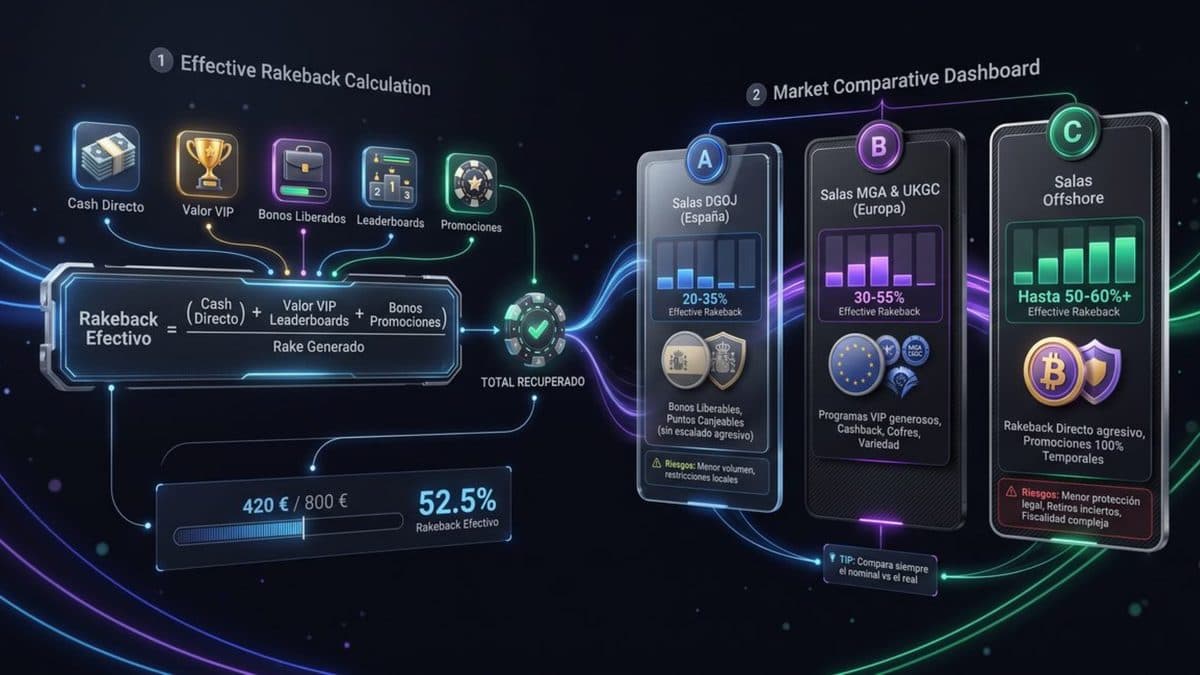
Effective rakeback comparison
## Rakeback's impact on your ROI and bankroll
For a regular player, rakeback isn't anecdotal: it can represent 30-70% of your total winnings, especially at lower and mid-stakes where margins are tight.
Example: breakeven table player
Assume a NL25 cash player who:
- •Generates €400 in rake/month
- •Winrate at table: 0 bb/100 (breakeven before rake)
- •Effective rakeback: 40% (€160/month)
Without rakeback: loses €400/month (the rake)
With rakeback: loses €240/month (net rake)
Tip: If your table winrate is marginal (1-3 bb/100), maximizing rakeback and rewards can be the difference between winning and losing long-term. Don't overlook this aspect.
Rakeback Structure Comparison by Network (2026)
| Network/Room | Rakeback Type | Effective Range | Calculation Method | Market |
|---|---|---|---|---|
| iPoker | Tiered VIP + bonuses | 25-45% | Weighted contributed | Europe |
| Chico Network | Direct + Elite Benefits | 30-55% | Contributed | International |
| Winning Network | Points + leaderboards | 20-40% | Contributed | Europe |
| Restricted market rooms | Bonuses + promotions | 20-35% | Weighted contributed | Local |
| Crypto offshore rooms | Direct + hybrid VIP | 33-60%+ | Varies | International |
Indicative data based on public structure analysis, March 2026. Your actual effective rakeback depends on monthly volume, VIP tier achieved, and ability to leverage leaderboards and active promotions.
Warning: This table shows approximate ranges. Your true effective rakeback will vary based on your monthly volume, VIP level reached, and how effectively you exploit leaderboards and promotional offers. Always verify current terms directly with the room.
[Insert image: comparative infographic of poker networks and their effective rakeback]## Advantages and limitations of rakeback as a regular player
Main advantages:
- •Predictable income: unlike table variance, rakeback is relatively constant month to month
- •Reduces results pressure: you can have a losing month at the tables and still recover significantly via rakeback
- •Improves your real ROI: especially important at low/mid-stakes with tight margins
- •Rewards volume: the more you play (wisely), the more you recover
Limitations and considerations:
- •Doesn't turn losers into winners: if your game is structurally losing, rakeback only slows the loss rate
- •Can incentivize bad volume: the temptation to play more for rakeback can lead to tired sessions or bad games
- •Complex tax implications: in many jurisdictions rakeback counts as taxable income; worth confirming with a tax advisor
- •Volatility by structure: in rooms with indirect systems (chests, leaderboards), actual rakeback fluctuates and can be frustrating to optimize
⚠ Important: Rakeback taxation can vary by country and personal tax situation. This content is informational and does not constitute tax or legal advice. Consult a qualified professional in your jurisdiction.
Practical tips to maximize your effective rakeback
1. Calculate your real rakeback, not marketing claims
Don't settle for the advertised percentage. Add it all up: VIP, bonuses, leaderboards, missions. Only then will you know which room truly compensates you best.
2. Compare structures by your profile
If you play 20 hours/week in cash, a tiered VIP room suits you better than flat low rakeback. If you play part-time, direct flat is usually better than systems rewarding extreme volume.
Pro tip: Before choosing a room for rakeback, look at the effective return percentage at the volume you'll actually play, not the nominal table maximum. A 60% rate for high-stakes is worthless if you play NL25 part-time.
3. Don't sacrifice EV for rakeback
A bad game with 50% rakeback is worse than a good game with 30% rakeback. Table winnings should always be your priority.
4. Capitalize on temporary promotions
Some rooms launch periods of increased rakeback (double VIP, special bonuses, etc.). If you play there already, concentrate volume during those windows.
5. Register through trusted affiliates
Registering directly with the room usually gives you a worse deal than signing up through a reputable affiliate. The best deals are rarely on the room's public website.
FAQ: Rakeback Questions & Answers
Is rakeback calculated on my winnings or on the rake I pay?
Rakeback is calculated on the rake generated, not on your winnings or losses. It doesn't matter whether you win or lose at the table-rakeback is based solely on the commission you pay to the room.
Can I earn rakeback at multiple poker rooms simultaneously?
Yes, absolutely. Each room manages its own rakeback program independently. Many regulars diversify across 2-3 rooms to optimize player pools, game schedules, and reward structures.
Do regulated poker rooms in restricted markets offer rakeback?
Yes, though with adapted structures: unlockable bonuses, redeemable points, and special promotions. Direct flat rakeback is less common in licensed rooms compared to offshore operators.
How does rakeback affect my taxes?
Tax treatment varies by country and your personal tax situation. In many jurisdictions, rakeback is considered taxable income. It's worth confirming with a qualified tax professional before making any assumptions about your specific circumstances.## Start optimizing your rakeback in 2026
For any regular player, understanding poker rakeback and calculating your true effective rakeback is as important as improving your table strategy. It can represent a significant portion of your annual winnings.
Review how much rake you generate monthly, add up ALL the returns you receive (cash, VIP, bonuses, leaderboards), and calculate your effective rakeback. You'll likely discover improvement opportunities.
When you register through PokerDealsAI, you accumulate AI Points on your regular volume. These points work independently of the room's rakeback: calculated automatically on your verified activity and redeemable for cash, tournament tickets, or catalog rewards. They don't affect or reduce the rakeback you already receive from the room, since both benefits are managed separately.
Want to compare current best rakeback offers? Check our room guides like PokerKing, WPT Global, or BetKings for complete structures, effective rakeback examples, and how to accumulate program points at each one.