MTT Strategy 2026: Complete Guide to Dominating Poker Tournaments

Key fact: MTT tournaments require constant adaptation. Play tight in early stages (preserve your stack), increase aggression in middle stages (accumulate chips), pressure the bubble (exploit ICM fear), and master final table dynamics (maximize equity). The costliest mistakes happen on the bubble and when you ignore your stack depth in big blinds.
Ever wondered why some players consistently reach final tables while you're busting on the bubble? The difference isn't the cards you're dealt—it's how you adapt your MTT strategy to each tournament phase.
In 2026, with increasingly competitive fields at rooms like PartyPoker Spain, CoinPoker, and BetOnline, you need concrete edges to stand out: these rooms offer rakeback up to 30-40% that returns a portion of your tournament fees directly to your account, welcome bonuses reaching $1,000+ to boost your starting bankroll, and tournament structures with 10-15 minute levels that enable deep strategic play. Additionally, by registering through PokerDealsAI, you access AI Points—a reward program independent of room rakeback that accumulates monthly and delivers extra value via cashback, exclusive freerolls, or tournament entries.
This guide takes you phase-by-phase through an MTT from registration to final table, with concrete ranges, ICM poker concepts, and the mistakes costing you equity every time you sit down.
MTT Tournament Phases: Your Strategic Roadmap
Every tournament is a journey of survival, accumulation, and equity maximization. Identifying where you are and what you need to do makes the difference between busting on the bubble and reaching the final table.

Premium stack of poker chips representing early MTT stage strategy
Phase 1: Early Stage (Levels 1-8, Deep Stack)
At tournament start, everyone has deep stacks (100+ BBs) and blinds are negligible. This isn't the time to win the tournament, but you can lose it with unnecessary heroics. Your main objective is survival without chip bleeding and establishing table image.
#### Tight-Aggressive Strategy
- •Play premium hands only: AA-TT, AK-AJ, and suited connectors in position. Fold marginal hands out of position.
- •Observe your table: Identify loose players who'll pay value bets, passive players you can steal from, and TAG players respecting your range.
- •Don't marry medium pairs: Facing serious aggression with JJ or TT? Remember early ranges are loaded with premium hands.
Tip: Use this phase for mental notes. Who's making automatic c-bets? Who folds to 3-bets? This intel becomes gold in middle stages.
At rooms with high recreational concentrations early—especially in bounty tournaments at PartyPoker.es—you'll see loose play everywhere. Don't match it. Your goal is reaching middle stages with a healthy stack while they eliminate each other.
#### Early Stage Stack Management
| Stack Situation | Recommended Strategy |
|---|---|
| 100+ BBs | Tight-aggressive; premium only from early position, expand in late position |
| 60-100 BBs | Maintain discipline; avoid marginal hand commitments |
| <60 BBs | Reassess: Do you need a mental table change? You still have time to recover |

Holographic growth chart showing middle stage MTT chip accumulation strategy
Phase 2: Middle Stage (Levels 9-15, Blinds Mounting)
This is where passive players slowly bleed out. Blinds start biting (25-50 BBs is common), and waiting for premium hands leaves you progressively blinded away. Time to widen your range and steal pots. Your main objective is aggressive chip accumulation before blinds devour your stack.
#### Accumulation Strategy
- •Expand steal ranges: From late position (CO, BTN), open any playable hand (Ax suited, suited connectors, broadways, small pairs).
- •Pressure medium stacks: Players with 20-40 BBs fear commitment. Attack them with frequent 3-bets and c-bets.
- •Respect loose big stacks: If someone has 80+ BBs and plays aggressively, avoid confrontations without premium holdings or clear equity.
Pro tip: Many intermediate players underestimate position's importance in middle stages. A button steal with Q8s can be +EV against blinds that fold 70% of the time, but that same hand from UTG is suicide.
At BetOnline, where turbo and semi-turbo structures are popular, this phase arrives quickly. On 8-minute level tournaments, your accumulation window is narrower.
#### Middle Stage Stack Management
| Stack Situation | Recommended Strategy |
|---|---|
| 50+ BBs | Calculated aggression: steal, light 3-bet in position |
| 25-50 BBs | Hunt favorable all-in spots (push/fold with 15-25 BBs) |
| <25 BBs | Push/fold mode: seek hands with >40% equity against calling ranges |

Futuristic hourglass with poker chips, representing time management and MTT poker tournament strategy
Phase 3: The Bubble (Maximum Pressure, Fear of Money)
The bubble is one of poker's most misunderstood moments. Many players freeze, waiting for others to bust to "secure" min-cash. That's -EV thinking. Your main objective is exploiting the fear of desperate players chasing ITM status.
#### Bubble Strategy
- •With a big stack (30+ BBs): Terrorize medium and short stacks. Steal blinds constantly, especially from players with 10-20 BBs who can't afford all-in without a hand.
- •With a medium stack (15-30 BBs): Be selective but aggressive. Hunt all-in spots against tight players who fold too much.
- •With a short stack (<15 BBs): Ignore the bubble. Your goal is doubling up, not min-cashing.
Key fact: Typical min-cash pays 1.5-2x your buy-in. If you fold for 5 hands with 10 BBs waiting for others to bust, you lose more equity than that min-cash is worth.
The bubble at large PartyPoker.es tournaments can last 20-30 minutes. That's prime time to accumulate without resistance. While others freeze, you're doubling your stack stealing without showdown.

Luxury money briefcase showing in the money MTT phase
Phase 4: In The Money (ITM) and Race to Final Table
You're in the money. Now the real tournament begins. Your min-cash is locked in, but significant pay jumps are waiting in the top 10-15%. Here's where ICM (Independent Chip Model) becomes critical. Your main objective is maximizing equity while considering ICM poker and payout structure.
#### What Is ICM Poker and Why It Matters
ICM assigns monetary value to your chips based on payouts and other stacks. Unlike cash games (where 1 chip = 1 unit always), in tournaments your chips are worth more or less depending on relative stack depth.
Practical example:
- •20 players left, paid to 15th.
- •You have 30 BBs (medium stack).
- •You shove AQ and lose to a big stack's call.
- •Result: You eliminated your chance at major pay jumps on a coin flip.
According to ICM poker, that all-in can be -EV even with 50% equity, because losing costs more tournament value than doubling wins you.
#### ITM Strategy Based on ICM
| Stack Situation | Recommended Strategy |
|---|---|
| Big stack (top 20%) | Pressure conservative medium stacks; avoid big stack battles without premium hands |
| Medium stack (30-60 percentile) | Play ICM-aware conservatively; hunt clear +EV spots |
| Short stack (<20 percentile) | Partially ignore ICM; focus on doubling back into contention |
Warning: ICM doesn't mean always folding. It means understanding when a chip-+EV all-in is tournament -EV.

Golden crown representing final table MTT strategy and victory
Final Table MTT Strategy: Where ICM Rules
You've reached the final table. This is peak ICM pressure, and wrong decisions cost thousands in equity. Dynamics shift hand-to-hand, and your adaptability determines whether you finish third or hoist the trophy.
Final Table Dynamics
Power structure at a final table changes constantly with each elimination. A chip leader becomes medium stack after losing a flip; a short stack climbs positions if others bust. Your strategy must adapt hand-to-hand.
- •Position matters more than ever: Being on the button with initiative lets you steal blinds from players who can't risk tangling with you.
- •Watch relative stacks: If someone has 5 BBs, everyone's in "survival mode" waiting for them to bust. That's your steal window.
- •Deals and negotiations: At many rooms (especially large BetOnline tournaments), players can propose chip chops based on ICM or chip count.
#### Final Table Strategy by Stack
Chip Leader (Big Stack):
- •Constantly pressure medium stacks that can't afford elimination.
- •Avoid unnecessary battles with the second-biggest stack.
- •Steal blinds from short stacks tight enough to ladder up.
Medium Stack:
- •Play conservatively with ICM awareness.
- •Hunt clear +EV spots against short stacks.
- •Don't tangle with big stacks without premium hands (top 10% of your range).
Short Stack:
- •Ignore ICM. Your goal is doubling up.
- •Hunt all-in spots with hands holding >45% equity against calling ranges.
- •Don't wait for miracles: AQ with 8 BBs is a clear shove.
Pro tip: At final tables, massive equity comes from uncontested pots. Stealing blinds and forcing folds usually outvalue coin flip all-ins.
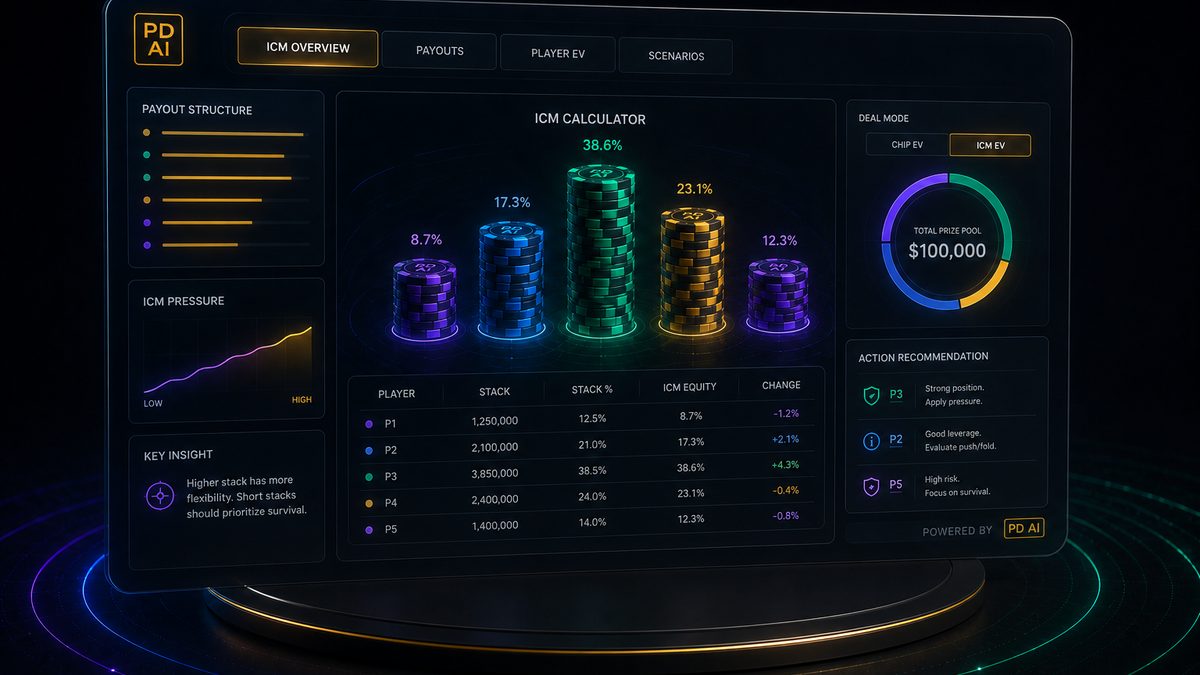
Futuristic holographic analytics dashboard for ICM calculations
Fatal Mistakes Draining Your Equity
Knowing typical mistakes lets you avoid them at critical moments. These four errors appear repeatedly in hand databases, each costing significant equity long-term.
1. Failing to Adjust Ranges by Stack Depth in Big Blinds
Playing 15 BBs like you have 50 BBs is suicide. Below 20 BBs, postflop play is impossible. Switch to push/fold mode.
2. Ignoring ICM During Bubble and Final Table
Making tournament decisions with cash game mentality gifts away equity. A 50% coin flip can be -EV in tournament value.
3. Folding Too Much in Middle Stage
If your VPIP (voluntarily put money in pot) in middle stages is <20%, you're letting blinds devour you. Open wider ranges in late position.
4. Over-Pressuring with Medium Stack on Bubble
Having 20-30 BBs and shoving loose on the bubble means big stacks call light just to bust you.
Tools and Software for MTT Success in 2026
Modern poker demands more than instinct. These legal tools work across most rooms:
- •ICMizer: Simulates tournament spots and calculates equity considering ICM. Essential for improving bubble and final table decisions.
- •HoldemResources Calculator (HRC): Similar to ICMizer, emphasizing push/fold ranges.
- •PokerTracker / Hold'em Manager: Track your stats (VPIP, PFR, 3-bet%, etc.) and opponents'. Identify leaks in your game.
Key fact: Research shows consistent +ROI players dedicate 40-60% of their time to study away from the tables.
2026 MTT Tips: Where to Play
Not all tournaments are equal. Structure (levels, blinds, starting stack) dramatically impacts your MTT strategy and results.
Recommended Structures
| Room | Structure | Advantage |
|---|---|---|
| PartyPoker.es | 12-min levels, deep stack | More postflop time; ideal for learning |
| CoinPoker | 10-min levels, turbo available | Variety of structures; great for adaptation practice |
| BetOnline | 8-15 min levels, hybrid | Competitive fields; perfect for improving under pressure |
Deep stack structures (12-15 minute levels, 200+ BB starts) give you error margin and are ideal for learning. Turbos (5-8 minute levels) demand quick decisions and favor push/fold specialists.
When you register at these rooms through PokerDealsAI, you unlock the AI Points program—independent rewards that accumulate separately from room rakeback.
Conclusion: Adaptation Is Your Secret Weapon
MTT tournaments aren't won in one hand or one phase. They're won by constantly adapting to:
- •Your stack depth in big blinds
- •The tournament phase
- •Your table's tendencies
- •The payout structure (ICM)
Players ignoring these factors and "playing their style" end up with flat ROI graphs and stalled bankrolls. Those mastering adaptation reach final tables consistently.
Frequently Asked Questions (FAQ)
What's the biggest early stage MTT mistake?
Overvaluing marginal hands (medium pairs, AQ offsuit out of position) and committing too many chips without clear equity. Early on, stack preservation beats chip accumulation.
When should I switch to push/fold mode?
When your stack drops below 15-20 BBs. At this depth, postflop play is nearly impossible and you're reduced to all-in or fold decisions preflop.
What is ICM and why does it matter in tournaments?
ICM (Independent Chip Model) assigns monetary value to your chips based on payout structure and other players' stacks. In poker tournaments, chips don't scale linearly: losing chips costs more equity than gaining the same amount wins you, especially near big pay jumps.
Should I play differently in turbo vs. standard structures?
Yes. In turbos (5-8 minute levels), blinds rise rapidly and deep postflop play nearly vanishes. You need more blind-stealing aggression and enter push/fold earlier (15-25 BBs instead of 10-15 BBs).
Is it ever worth folding on the bubble to secure min-cash?
Rarely. Typical min-cash (1.5-2x buy-in) is tiny compared to equity you lose by not accumulating for bigger pay jumps. The only exception: you have <5 BBs with unplayable cards.
What's the best tool for learning ICM?
ICMizer is used by professional players and lets you simulate thousands of tournament spots. It has a learning curve but shows whether your decisions are +EV or -EV considering payouts.