Poker Multitabling 2026: Complete 4-9 Tables Guide
The Essentials:
- •Optimal tables by format: Cash games 6-9 tables, MTTs 4-6, Spin&Go up to 12
- •Safe progression: Start with 2-3 tables, add 1-2 only after 10,000+ hands without winrate decline
- •Minimum setup: 2x 24" monitors for 6-9 tables in tile, hotkeys mandatory
- •Adjusted bankroll: Minimum 30 buy-ins (6 tables = 6 buy-ins at simultaneous risk)
- •Approved software: Captions and HUDs per room rules. Table Ninja and StarsHelper may be prohibited
Multitable poker-playing multiple poker tables simultaneously-is the most effective volume multiplier for online grinders in 2026. According to the Jurojin Report 2026 (analysis of 25,000+ players), current averages range between 4-9 simultaneous tables, with Europe leading in tables-per-player thanks to large-screen access and stable connections.
Maximizing volume isn't just opening more tables. Do it wrong and you'll destroy your winrate, generate missclicks, and accelerate tilt. This guide shows you how to scale profitably, with proper physical setup, adapted strategy, and when to reduce tables before it's too late.
Why Multitabling Multiplies Your Profits (If Done Right)
Playing more tables increases your hands-per-hour volume, creating three direct effects:
- 1.More rakeback per session: You generate more rake and VIP points. Playing rooms with flat rakeback like CoinPoker (15% daily) or PartyPoker.es, 6 tables generate approximately 3x more points than 2 tables.
- 2.Optimized hourly rate: A winning player at 3bb/100 playing 6 simultaneous tables can exceed total earnings of one at 4bb/100 on 2 tables, simply through volume. Maintaining acceptable winrate while scaling determines your final profitability.
- 3.Lower variance impact: In cash games, distributing your bankroll across multiple tables reduces session swings. A downswing at one table doesn't ruin your entire session.
Key fact: According to Easy American Poker, European grinders average 6-9 tables in regular cash, while in fast-fold (Zoom, Rush & Cash) the average drops to 2-3 due to decision speed.
But there's a critical threshold: adding tables without game adjustments lowers your EV. If you move from 4 to 9 tables playing identically, you'll make more mistakes, miss value spots, and leave money on the table in exploitable situations.
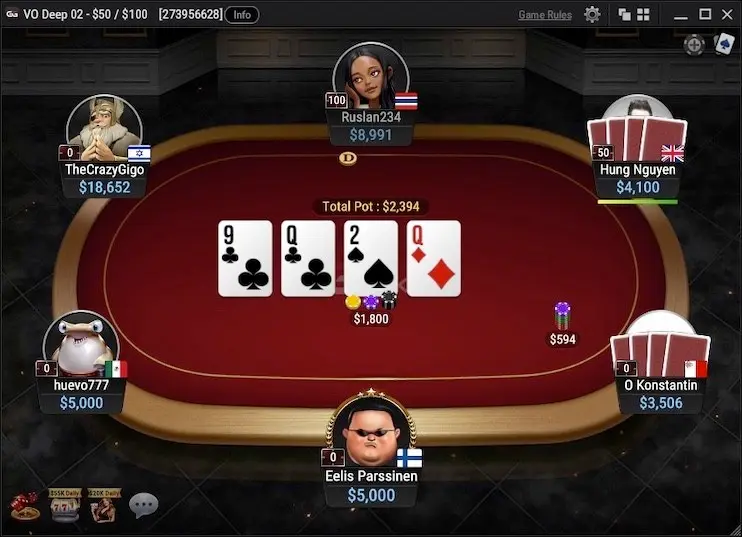
poker room screenshot
Multitable Poker Fundamentals: How Many Tables to Play by Format and Level
No universal number exists. It depends on format (cash, MTT, Spin&Go), your experience level, and the room you're in. Understanding how many poker tables to play is foundational to scaling without losing profitability.
| Format | Beginner (first 6 months) | Intermediate (winning at your stake) | High-Volume Grinder |
|---|---|---|---|
| Regular cash (6-max/full ring) | 1-2 tables | 4 tables | 6-9 tables |
| Fast-fold (Zoom/Rush) | 1 table | 2 tables | 3 tables |
| Spin & Go | 2 tables | 4 tables | 6-8 tables |
| Standard SNG | 2 tables | 4 tables | 8-12 tables |
| MTT | 2 tables | 4-6 tables | 8-14 tables (reduce to 1-2 at final tables) |
Cash Games: The Most Multitabling-Friendly Format
Cash games allow repetitive decisions and more automatable ranges. An intermediate player with solid fundamentals can comfortably play 6 simultaneous tables without quality loss. PokerStars allows up to 24 Hold'em tables with automatic resizing, though few players exceed 12 without advanced software.
In fast-fold (Zoom, Rush & Cash), hand velocity multiplies, so 2-3 tables equal 6-8 in regular cash. Don't scale equally. If you start practicing multitable cash, rooms like CoinPoker offer stable software with no official table limit and 15% daily rakeback-ideal for volume accumulation from the start. Separately, registering through PokerDealsAI earns you AI Points for every dollar of revenue generated, independent of room rakeback.
MTTs: Fewer Tables, More ICM
Multi-table tournaments require constant ICM adjustments, bubble play, and stack-size strategy. Playing more than 6 MTTs simultaneously is viable only for experienced grinders with organization software. At late stages and final tables, reduce to 1-2 tables to maximize EV in critical spots.
GGPoker optimizes MTT multitabling with tools like All-in Insurance, but decision complexity remains higher than cash.
Spin&Go and Sit&Go: Hyper-Turbo Volume
Hyper-turbo formats allow 10-20 simultaneous tables because most play happens in push/fold mode. But variance is brutal: you need a large bankroll (minimum 100 buy-ins) and swing tolerance.
For standard SNGs, the slower structure allows 8-12 tables with more comfortable decisions than Spins.
Tip: If you play licensed Spanish rooms (DGOJ) like PartyPoker.es, software restrictions and table limits may be stricter. Always check terms of use.
Physical Setup: Monitors, Layout, and Minimum Hardware
Physical configuration separates comfortable play from losing focus in 30 minutes.
| Configuration | Max recommended tables | Ideal for |
|---|---|---|
| 1x 24" monitor | 4 (tile) / 6 (cascade) | Beginners, casual players |
| 2x 24" monitors | 6-9 (tile) | Intermediates (1 for tables, 1 for lobby/software) |
| 3+ monitors | 10-24 | Professionals, MTT grinders with multiple tournaments |
Table Layouts: Tile vs Cascade vs Stack
- •Tile (grid): Tables arranged in grid without overlap. You see all tables simultaneously. Ideal for 4-6 tables on one monitor or up to 12 on two. Requires large screens for readable tables.
- •Cascade: Tables stacked with visible edges. Saves space and uses hotkeys to act without window switching. Useful for 6-9 tables on medium screens.
- •Stack: Tables completely overlapped; the one needing action appears automatically front. For 8-20 tables in hyper-turbo formats. Requires configured hotkeys and full system confidence.
Tip: Always enable 4-color deck (hearts red, spades black, clubs green, diamonds blue) to avoid suit confusion in quick decisions. Organize tables by descending blinds: high stakes top-left, low stakes bottom-right.
Recommended Hardware for 6-9 Tables
| Component | Minimum (4-6 tables) | Recommended (6-9 tables) | Professional (12+ tables) |
|---|---|---|---|
| RAM | 8GB | 16GB | 32GB |
| Processor | i5 or equivalent | i7 or Ryzen 7 | i9 or Ryzen 9 |
| Connection | 10 Mbps | 20 Mbps | 50+ Mbps fiber |
| Approx. investment | $700-900 | $1,400-1,700 | $2,800+ |
Unstable connection is deadly in multitabling. A timeout on a key decision can cost you a full buy-in. If playing from Spain or Europe, fiber optic is standard, but check latency for international rooms like CoinPoker.
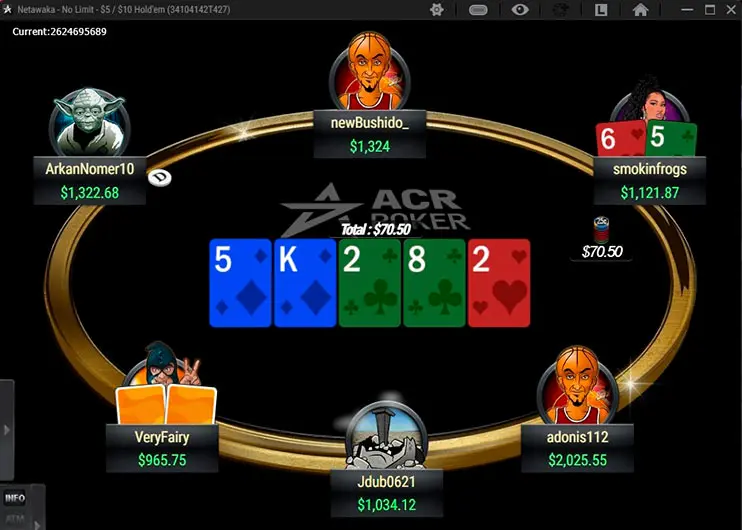
poker room screenshot
Multitable Strategy: How to Adapt Your Game to Multiple Tables
When playing multiple tables simultaneously, you cannot play identically to single-table. Good multitable strategy simplifies ranges, reduces complex bluffs, and automates decisions.
Preflop: Fixed Ranges and Less Marginality
In multitabling, you lack time for dynamic adjustments per opponent. Use standardized tight-aggressive ranges:
- •Reduce marginal early position opens: Eliminate weak suited connectors (76s, 54s) without clear opponent reads.
- •Fixed 3-bet ranges by position: Define 3-bet range from BTN, CO, blinds-no improvisation.
- •Calls vs 3-bets by pot odds and position: Without clear odds or out-of-position, fold. Avoid speculative hands requiring complex postflop decisions.
Warning: Tight ranges don't mean scared play. Stay aggressive but with clear criteria. If you open 22% UTG in single-table, drop to 18-20% in multitable by eliminating marginal combos.
Postflop: More Direct Value Betting, Fewer Multi-Street Bluffs
In multitabling, avoid complex bluffs requiring multi-street analysis. Focus on:
- •Value betting strong hands: With top pair strong kicker or better, bet directly. No unnecessary slowplays.
- •Folding marginal spots without clear reads: If unsure whether villain is aggressive or tight, and the decision is 50/50, fold and focus on the next hand.
- •Bluffing only obvious spots: CB on dry flop like A72r after CO open is automatic. Triple-barrel bluff on dynamic board requires attention you don't have.
Hotkeys: Non-Negotiable
Configuring hotkeys for bet, fold, check, call, and bet sizing presets is mandatory. Without them, you lose critical seconds per decision, accumulating fatigue and timeouts.
Most rooms allow native keyboard shortcuts. Practice until they're automatic. Basic setup:
- •F: Fold
- •C: Call/Check
- •B: Bet/Raise (with default sizing)
- •1/2/3: Sizing presets (33%, 50%, 75% pot)
Warning: Verify your room allows hotkeys before playing. DGOJ-regulated Spanish rooms may have stricter restrictions.
Approved Software in 2026 Multitable Poker
Assistance software can multiply efficiency, but using prohibited tools risks permanent ban. Rules vary by room.
HUDs: Legal in Most International Rooms
PokerTracker 4, Hand2Note, and Holdem Manager 3 are legal in rooms like CoinPoker, BetKings, and most WPN skins. Not permitted in DGOJ rooms (Spain) like PartyPoker.es, Bwin.es, or Casino Barcelona.
HUDs display real-time opponent stats (VPIP, PFR, 3-bet%, etc.), accelerating exploitable decisions.
Table Management: Caption and Similar
Caption is specialized multitable software that auto-organizes windows by room. Useful for PokerStars, GGPoker, and other major sites. Always check your room's terms before installation.
PROHIBITED Software
- •StarsHelper: Banned on PokerStars since 2026. Auto-detects players and displays live stats without proprietary database.
- •Table Ninja: Room-dependent. Permitted on PokerStars but violates ToS elsewhere. Verify first.
- •Real-time solvers: Any software calculating GTO ranges live during play is banned in all serious rooms.
Warning: Playing DGOJ-licensed Spanish rooms means zero HUDs, zero external software. If tools are priority, focus on international rooms with MGA or Curaçao licenses.
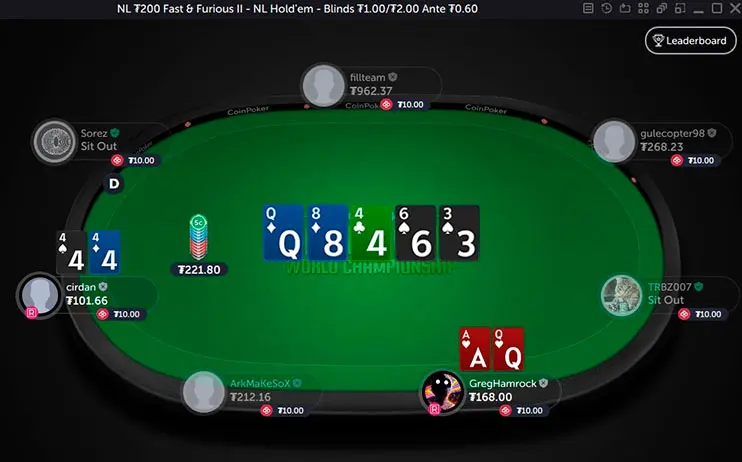
poker room screenshot
Safe Progression: How to Scale Without Destroying Your Winrate
The temptation to open 10 tables day one is real. Don't. Correct progression is gradual and data-driven.
Phase 1: Start with 2-3 Tables (Weeks 1-2)
Play 2-3 tables maximum for your first two weeks. Focus on:
- •Identifying regular and recreational players.
- •Taking notes on exploitable tendencies (3-bet%, fold to CB, etc.).
- •Adjusting ranges based on player pool dynamics.
Don't progress until your winrate is positive over at least 10,000 hands.
Phase 2: Add 1-2 Tables Per 10,000 Hands
Once winrate stabilizes, add 1-2 additional tables. Monitor winrate every 10,000 hands. If it drops significantly (over 1bb/100 without variance explanation), return to previous table count.
Phase 3: Find Your Optimal Limit
Your optimal table count is where you maximize hourly rate without losing decision quality. For most intermediate grinders, that's 4-6 tables in regular cash or 2-3 in fast-fold.
| Experience Level | Recommended Tables | Expected ROI | Monthly Volume (100h) | Profile |
|---|---|---|---|---|
| Beginner | 2-4 tables | Maximum | 20,000-40,000 hands | Learning fundamentals, decision focus |
| Intermediate | 4-6 tables | High | 40,000-60,000 hands | Solid ranges, partial automation |
| Advanced | 6-9 tables | Medium-high | 60,000-90,000 hands | Fast decisions, optimized software |
| Professional | 9-24+ tables | Variable | 90,000-240,000+ hands | Pro setup, hyper-turbo formats |
Tip: Play more tables when: games are soft (recreational hours), active bonus/rakeback race, well-rested. Reduce tables when: facing tough players, tired, or past 2 hours without break.
How to Play Multiple Poker Tables Without Losing EV: Core Principles
The main challenge in learning how to play multiple poker tables isn't table count-it's maintaining decision quality while increasing volume. Here are core principles:
Prioritize High-EV Spots
With 6-8 tables open, you can't analyze every situation deeply. Quickly identify highest-impact decisions:
- •Preflop 3-bets and 4-bets: These affect large pots. Take necessary time.
- •River bets vs checks in medium-large pots: Error here costs several BBs.
- •Thin value spots: When unsure, check. Don't force marginal value when multitabling.
For routine hands (fold UTG with 72o, auto CB on dry flop), decide in under 2 seconds. Reserve mental bandwidth for critical decisions.
Aggressive Table Selection
Not all tables are equally profitable. If a table becomes tough (multiple regs, no recreationals), close it and open another. Don't stay at unprofitable tables from inertia.
Most modern rooms have automatic waiting lists. Set filters to sit only at tables with 2+ recreationals (VPIP >35%, under 500 hands played).
Mental Energy Management
Each decision burns cognitive energy. After 90-120 minutes playing 6+ tables, error rates spike significantly. Take breaks hourly: stand, stretch, hydrate.
If fatigue hits before your planned session ends, reduce tables rather than autopilot. Better 4 focused tables than 8 on autopilot.
Bankroll Management Adjusted for Multitabling
Playing multiple tables simultaneously increases simultaneous risk exposure. Playing 6 tables of NL50 with 100bb stacks means 6 buy-ins at risk simultaneously.
Standard rule: minimum 30 buy-ins for your stake. Playing NL50 ($50 buy-in) requires $1,500 minimum bankroll. For high-variance formats (Spin&Go, MTTs), increase to 100 buy-ins.
This assumes positive winrate. If break-even or losing, move down or reduce tables before continuing.
Red Flags: When to Reduce Tables NOW
Mistaken multitabling creates cascading errors. Reduce tables immediately if you detect:
- 1.Frequent missclicks: Accidentally folding strong hands or betting when wanting to check. One isolated missclick is normal; two per session signals overload.
- 2.Regular timeouts: Losing time on routine decisions means too many tables.
- 3.Negative winrate over 5,000+ hands: Variance explains 2,000-3,000 hand swings, but 5,000 hands negative is sufficient data to adjust.
- 4.Stress or frustration: Ending sessions mentally exhausted or on autopilot means too many tables.
- 5.No recall of key hands: Forgetting important decisions when reviewing means lost concentration.
Warning: Autopilot is multitabling's silent killer. Autopilot means failing to exploit opponents, missing value bets, and not adjusting to table dynamics. When autopilot kicks in, reduce tables or take a break.
Most Multitable-Friendly Platforms in 2026
Not all rooms offer equal multitable experiences.
PokerStars: Multitabling King in Cash
PokerStars allows up to 24 simultaneous Hold'em tables with auto-resizing and advanced tile/cascade options. Software is market-optimized for high volume. But medium-high stakes traffic demands solid play.
PartyPoker.es: 4-Table Cap
PartyPoker.es (DGOJ license) allows maximum 4 simultaneous tables-regulatory responsible play limit. If volume is priority, not your main room. But Spanish recreational traffic during peak hours compensates.
CoinPoker: No Official Limit, Crypto-Grinder Friendly
CoinPoker imposes no table limit, though software isn't as polished as PokerStars. 6-9 tables in regular cash is viable without technical issues. Bonus: USDT/BTC deposits/withdrawals without fiat conversion.
Registering through PokerDealsAI earns additional AI Points per dollar of revenue generated, redeemable for bonuses or extra cashback beyond room rakeback.
GGPoker (via BetKings): Tournament-Friendly with Advanced Tools
GGPoker optimizes MTT multitabling with All-in Insurance and Smart HUD (ToS-compliant since built-in). Ideal for MTT grinders managing 8-14 simultaneous tournaments.
Common Mistakes That Destroy Your EV
1. Starting with Too Many Tables
Most players overestimate capacity. Start conservative (2-3 tables) and scale with data, not ego.
2. Not Adapting Strategy to Multitabling
Playing single-table style is fatal. Simplify ranges, reduce marginality, automate routine decisions.
3. No Hotkeys or Fixed Seat
Losing 2-3 seconds per decision at 6 tables = 12-18 seconds per round. Over 100 hands, that's 20-30 lost minutes. Configure keyboard shortcuts and fixed seat (available in most rooms) to avoid disorientation.
4. Ignoring Mental Management and Tilt
Multitabling accelerates tilt because bad beats stack faster. Losing flips at three tables in a row tempts revenge-play. Check our tilt control guide for specific techniques.
5. Not Reducing Tables in Late MTT Stages
Playing 10 MTTs and 3 reach final tables? Close the other 7 and focus on those. EV gained from optimal ICM decisions at finals far exceeds volume lost.
Real Advantages and Limits of Multitabling
Advantages:
- •Multiplies hands-per-hour and rakeback per session
- •Reduces emotional impact of individual bad beats (attention distributed)
- •Accelerates sample size to validate true winrate
- •Maximizes hourly rate with maintained decision quality
Limitations:
- •Requires hardware investment (monitors, RAM, stable connection)
- •Not all formats allow high volume (fast-fold and MTTs more demanding)
- •DGOJ Spanish rooms limit tables and ban assistance software
- •Autopilot and quality-loss risk
- •Higher bankroll requirements due to simultaneous exposure
Start Scaling Your Volume at Top Rooms
To maximize volume and rakeback in 2026, these rooms best support multitabling:
CoinPoker: No table limit, 15% daily rakeback, instant crypto deposits. Perfect for grinders prioritizing flat rakeback without conditions. Register via PokerDealsAI to earn additional AI Points per revenue dollar.
PartyPoker.es: 4-table maximum (DGOJ), but Spanish recreational traffic and exclusive tournaments. Ideal if you're Spain-based and prioritize regulatory safety.
For high-volume MTTs, BetKings (GGNetwork) offers optimized tools and 2026's largest tournament liquidity.
Register through PokerDealsAI and start with 2-3 tables. Scale gradually, monitor winrate, adjust by data. Executed properly, multitabling multiplies earnings; executed poorly, it destroys them.
Ready to scale your volume? Choose your room and start earning AI Points from hand one.