Poker Variance: How to Calculate It & Why It Matters
Poker Variance: What It Measures and Why It Matters
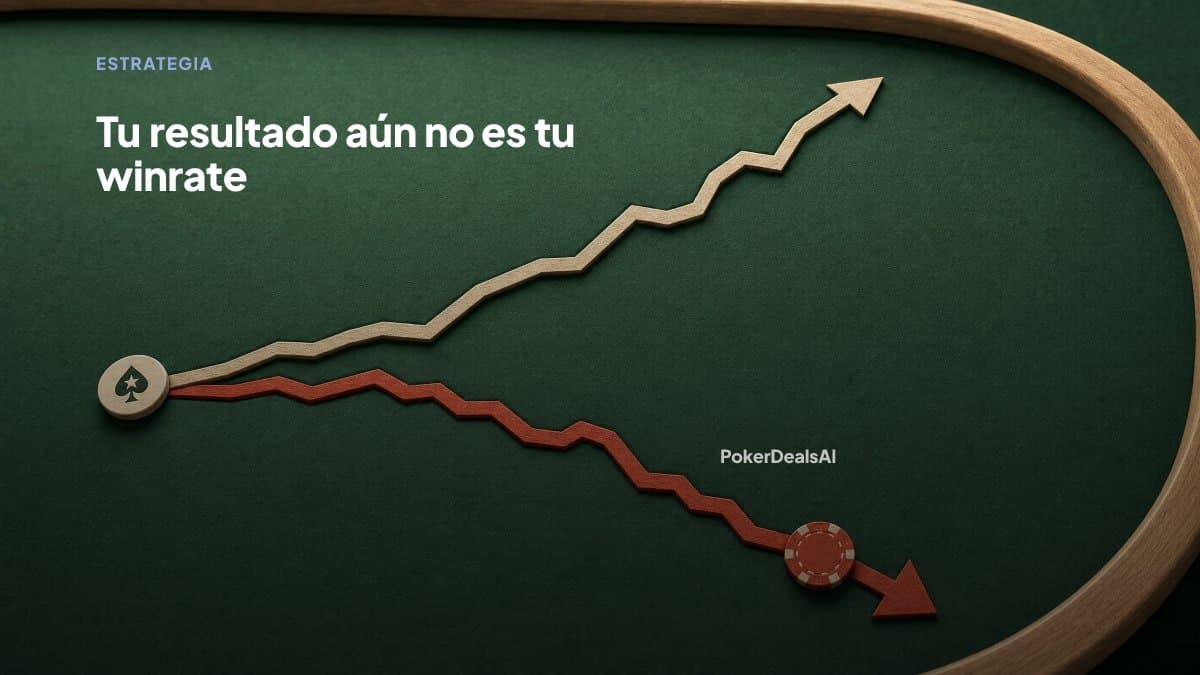
You win two weeks straight and think you've cracked poker. You lose the next three and start doubting your game. Neither feeling is entirely accurate: in most cases, what you're experiencing is variance. If you've searched "poker variance," you likely want to understand why your actual results don't match your theoretical winrate, and what to do with that information before it leads you to make poor bankroll decisions.
The essentials:
- Variance measures how far your actual results deviate from your expected value (EV), not whether you're playing well or poorly.
- It's measured using standard deviation: in cash games it's usually expressed in bb/100, while in tournaments it must be interpreted alongside ROI, field size, and payout structure—there's no universal equivalence between formats.
- A winning player can experience downswings of dozens of buy-ins without indicating a technical problem.
- MTTs and Spin&Gos have significantly higher variance than cash games, according to specialized calculator data.
- Managing bankroll and leveraging rakeback or rewards programs helps you survive swings, though it doesn't eliminate them.
Poker Variance: What It Measures and Why It Matters
Variance is a statistical dispersion measure: it indicates how much your individual results (hands, sessions, tournaments) deviate from your expected average [1][2]. In poker, that expected average is your EV—the result you "should" achieve long-term given your skill level.
The crucial distinction is that variance doesn't judge the quality of your decisions. You can play optimally and still experience consecutive losing weeks, because card variance and all-in outcomes accumulate on top of your real winrate [2][3]. The reverse also happens: players with technical leaks can run hot in ways that don't reflect their true skill level.
Key fact: a high standard deviation isn't synonymous with poor play. Formats like Spin&Gos or multi-table tournaments have structurally higher variance than cash games, regardless of how well you play [1][9].
How to Calculate Variance and Standard Deviation in Poker
Standard deviation is the square root of variance and is the figure you'll actually use in practice, because it's the operational measure of that dispersion. In cash games it's usually expressed in bb/100; in tournaments there's no equally direct unit—it should always be analyzed alongside ROI, field size, and payout structure, rather than chasing an isolated number [2][6][11].
If you have a history of results by session or hand block, manual calculation follows these steps:
- 1.Calculate the average of your results (for example, bb won per session).
- 2.Subtract the average from each individual result.
- 3.Square each of those differences.
- 4.Sum the squares and divide by (n-1)—standard practice in poker for sample data—to get variance.
- 5.Calculate the square root of that variance: that value is your standard deviation.
For this calculation to be meaningful, the blocks you compare should contain the same number of hands, or your results should be pre-normalized to bb/100. Directly comparing a 500-hand session with a 5,000-hand one, or mixing sessions of very different lengths without normalizing, distorts the resulting standard deviation and can lead you to wrong conclusions.
In practice, almost no one does this by hand. Tracking software like PokerTracker or Holdem Manager export your winrate in bb/100 directly and, in many cases, your associated standard deviation [1][12]. A volume of 50,000 hands in cash can serve as a first benchmark, but doesn't guarantee a precise estimate of your true winrate: depending on your own play variability, you might need several hundred thousand hands before that figure stabilizes reliably.
With those two data points—winrate and standard deviation—you can feed a variance calculator (Primedope, Phil Galfond Variance Calculator, PokerCharts, among others) that simulates, typically using Monte Carlo methods, the range of probable outcomes after X hands or tournaments [1][3][7][9].
Tip: before drawing conclusions about your skill level, export your actual history to a tracker and check your standard deviation in bb/100. Comparing your winrate against that figure gives you a much more honest picture of your situation than looking only at your month's profit in dollars.
Variance Differences by Format: Cash, MTT, and Spin&Go
Not all variance is created equal. The format you play largely determines how much your results will fluctuate in the short and medium term.
| Format | Typical Standard Deviation | What It Means in Practice |
|---|---|---|
| Cash NLHE 6-max online | 80–120 bb/100 (many calculators use 100 bb/100 as default) [7][10][12] | Downswings of several dozen buy-ins are possible even with a positive winrate |
| Cash full ring live | 80–120 bb/100, variable depending on table looseness [7][10] | Variance depends heavily on the specific table dynamics rather than the format itself |
| MTT / multi-table tournaments | Very high variance with no universal range comparable to cash bb/100; depends on field size and payout structure [8][9] | Small samples (hundreds of tournaments) can be far from expected ROI |
| Sit&Go / Spin&Go | Structurally high variance due to variable prize pools | Stretches without a big win are statistically normal, not an indicator of poor play |
Reference data from specialized variance calculators cited in research (Primedope, Phil Galfond Variance Calculator, PokerCharts). Actual values depend on your play style, rake, and table composition.
Warning: in tournaments, a sample of just a few hundred events tells you almost nothing about your true ROI. The extreme variance of MTTs means you need much larger volumes than cash to see your statistics stabilize.
Practical Example: Downswing and Bankroll Management
Imagine a 6-max cash player with an estimated winrate of +5 bb/100 and a standard deviation of 95 bb/100—values within the typical range cited by variance calculators [1][7][12]. When you input those numbers into a tool like Primedope or PokerCharts to simulate 100,000 hands, the typical result is a wide range of possible final outcomes, including scenarios where the player is net negative despite having positive long-term EV.
This type of simulation is why bankroll management guides emphasize playing with a sufficient cushion of buy-ins: the higher your standard deviation, the greater your risk of ruin if you play with a tight bankroll [3][7][9][10]. There's no universal figure that works for all players because it depends on your own winrate, standard deviation, and risk tolerance, but the higher your format's variance, the more conservative you should be with the number of buy-ins you risk at each level.
Pro tip: before moving up, simulate your situation first in a variance calculator using your real winrate and standard deviation. It's more useful than memorizing a "standard" number of buy-ins from a forum.
Advantages and Limits of Calculating Your Own Variance
Understanding your variance has genuine practical value, but also limits worth clarifying before relying too heavily on calculators.
Advantages:
- •It helps you distinguish a statistically normal downswing from a real technical leak in your game.
- •Allows you to calculate a reasonable bankroll based on your format and standard deviation, rather than using generic rules.
- •Reduces tilt: knowing a downswing of certain magnitude is mathematically expected helps prevent impulsive decisions.
- •Facilitates comparing formats (cash vs. MTT vs. Spin&Go) before deciding where to concentrate your volume.
Limits:
- •You need a reasonable minimum sample (tens of thousands of hands in cash, hundreds or thousands of tournaments in MTT) for your own calculated standard deviation to be meaningful; with small samples, error margins are high.
- •Variance calculators assume your true winrate remains stable, which doesn't always happen if you change levels, formats, or schedules.
- •Variance tells you nothing about specific leaks in your game (ranges, sizing, lines); for that you need hand review, not just aggregate statistics.
- •A result within the calculator's "normal" range doesn't guarantee your play is sound: it simply indicates the result is compatible with expected randomness.
Variance, Bankroll, and Cushioning the Swings
Variance can't be eliminated, but you can manage its impact on your actual bankroll. Two levers help concretely: bankroll size relative to your format, and additional income that reduces the pressure of each downswing.
Rakeback offered by regulated rooms is one such lever: by returning part of your rake, it smooths the effect of a losing streak on your net result. Rooms like PartyPoker or PokerStars offer loyalty programs worth reviewing before choosing where to concentrate your volume; check current terms at each room since tiers and percentages can vary.
Separately, PokerDealsAI offers AI Points for your activity at verified rooms, designed to partly cushion bankroll wear during negative variance.
Warning: rakeback and AI Points reduce the economic impact of a downswing, but don't change the statistical probability it occurs or reduce variance itself. No rewards program replaces proper bankroll management for your true standard deviation.
Frequently Asked Questions About Poker Variance
Can I be in a downswing for months while still being a winning player?
Yes. In high-variance formats like MTT or Spin&Go, a several-month downswing is compatible with long-term positive ROI, according to variance calculator simulations cited [8][9]. That doesn't mean every downswing is normal: review your hands if the streak lasts significantly longer than your own calculator estimates as reasonable.
How many hands do I need to trust my winrate?
There's no magic universal number. Around 50,000 hands can serve as a first reference, but doesn't guarantee a precise winrate estimate. Depending on your winrate and standard deviation, hundreds of thousands of hands may be necessary for more reliable conclusions [12]. In tournaments, because variance per event is much larger, proportionally larger samples are needed.
Does variance have any tax implications in my country?
Tax implications of poker winnings vary by your personal situation and local regulations. This content is informational and doesn't constitute tax or legal advice; confirm your specific case with a tax advisor before making decisions.
Start Playing at PartyPoker
Review current rakeback terms and accumulate AI Points through PokerDealsAI while managing your bankroll with real data on your own variance. Go to PartyPoker