What is Bankroll in Poker: Management Guide 2026

The Essentials:
- •Bankroll = money reserved exclusively for poker, separate from your personal finances
- •Cash games: 25-50 buy-ins (conservative: 40-50 BI)
- •MTT: 100-200 buy-ins depending on field size and structure
- •Spins/Jackpots: 100-300 buy-ins due to high variance
- •Golden rule: never risk more than 5% of your bankroll in a single session or tournament
- •Bankroll management prevents ruin, not losses
If you're new to online poker or have been playing for a while without a clear money management plan, this article explains what a poker bankroll is, what bankroll management means, and answers the most common question from new players: how much bankroll do I need to play each stake level in 2026 without risking ruin.
What Is a Poker Bankroll: Simple Definition
Your bankroll is the amount of money you reserve solely for playing poker. It's not your bank account, your salary, or your rent savings. It's a separate fund you use to pay tournament buy-ins, make deposits at online rooms, and buy into cash games.
The difference between a recreational player and a long-term winner lies in how they manage that money. Keeping your bankroll separate from your day-to-day finances means a few bad sessions won't destroy your personal economy and force you to quit just when you need volume to escape a downswing.
Why Bankroll Management Matters (Variance and Psychology)

Variance and psychology: why bankroll management protects your game
Poker has variance. You can play well for weeks and lose, or make every correct decision in a tournament and bust on the bubble. Without a properly-sized bankroll and clear rules on how much to risk, normal variance can leave you without funds before your edge shows up.
Bankroll management (BRM) consists of the rules you use to decide what stakes to play, when to move up or down, and how much to risk per session. Its goals: minimize the risk of ruin, absorb variance without fear dictating your decisions, and move up levels in an orderly way by dropping when your bankroll requires it.
Warning: Bankroll management doesn't prevent you from losing money in a bad session. It prevents a normal losing streak from leaving you without capital to keep playing.
The psychological factor is equally important as the mathematical one. If you play outside your bankroll, fear of losing will make you play too tight at crucial moments, fold +EV spots, and chase losses on tilt. With an adequate bankroll, you play relaxed knowing a bad session won't threaten your ability to continue.
Bankroll Requirements by Game Format (Cash, MTT, SNG, Spins)
There's no one-size-fits-all bankroll number. The variance in a 5,000-player turbo tournament is completely different from a full ring cash table, which is why your cash game bankroll and tournament bankroll should follow separate rules.
Cash Game No-Limit Hold'em
Standard recommendation for cash game bankroll: 25-50 buy-ins at your stake level.
- •Conservative (new players, low risk tolerance): 40-50 buy-ins
- •Standard/Aggressive (winning regulars): 25-30 buy-ins
Example: if you play NL10 (€10 buy-in), a conservative bankroll would be €500 (50 BI). With an aggressive approach, you could play NL10 with €250 (25 BI), but you need to be ready to drop to NL5 quickly if you lose 5-10 buy-ins.
MTT (Multi-Table Tournaments)
Minimum recommendation for tournament bankroll: 100 buy-ins of your average tournament buy-in.
- •Conservative (large fields, turbo structures): 150-200 buy-ins
- •Additional rule: never risk more than 1-2% of your bankroll on a single tournament
MTT variance is extremely high: you can run 50 tournaments without cashing without it meaning you're playing poorly. The larger the field and faster the structure, the more buy-ins you need.
Example: with a €1,000 bankroll, your average buy-in should be €10 (100 BI) or less. A single €50 tournament would represent 5% of your roll-too high. The 1-2% rule protects you from risking an excessive amount on one event.
Sit & Go and Spins (Jackpots)
Classic Spins: 100-150 buy-ins minimum. Nitro/Hyper-turbo Spins: 150-300 buy-ins.
Jackpot formats have extreme variance due to the random prize multiplier. Even with perfect play, you can hit 30-40 consecutive losing Spins before hitting a high multiplier.
Bankroll Comparison Table by Format
| Format | Recommended Buy-ins | Example (€10 BI) | Player Profile | |
|---|---|---|---|---|
| Cash NLHE Conservative | 40-50 BI | €400-500 | New players, low risk tolerance | |
| Cash NLHE Standard | 25-30 BI | €250-300 | Winning regulars | |
| MTT Standard | 100 BI | €1,000 | Average buy-in €10, fields <1,000 | |
| MTT Conservative | 150-200 BI | €1,500-2,000 | Large fields, turbos, tournament newcomers | |
| Classic Spins | 100-150 BI | €1,000-1,500 | Standard spins without extreme multipliers | |
| Nitro/Hyper Spins | 150-300 BI | €1,500-3,000 | Ultra-fast formats, high variance | ## Recommended Bankroll Table: NL2 to NL100 (Online Cash) |
This table uses the conservative 40 buy-in rule for each stake. If you're more aggressive and have a proven winrate, you can reduce to 25-30 BI, but understand that ruin risk increases.
| Stake | Blinds | Buy-in (100bb) | Bankroll 40 BI | Bankroll 50 BI |
|---|---|---|---|---|
| NL2 | 0.01/0.02 | $2 | $80 | $100 |
| NL5 | 0.02/0.05 | $5 | $200 | $250 |
| NL10 | 0.05/0.10 | $10 | $400 | $500 |
| NL25 | 0.10/0.25 | $25 | $1,000 | $1,250 |
| NL50 | 0.25/0.50 | $50 | $2,000 | $2,500 |
| NL100 | 0.50/1.00 | $100 | $4,000 | $5,000 |
Key fact: These figures are for online play. Live, many players use bigger bankrolls (50-100 BI) because they can't play as much volume and variance per hour is higher.
If you play at DGOJ-regulated rooms in Spain, limits typically start at NL5 or NL10: deposit at least 250€ for NL5 with safety. If you want to test without commitment, deposit 100€ and play NL2 at international rooms like CoinPoker or BetKings, which offer very low micro-stakes.
When to Move Up in Stakes (Progression Rules)
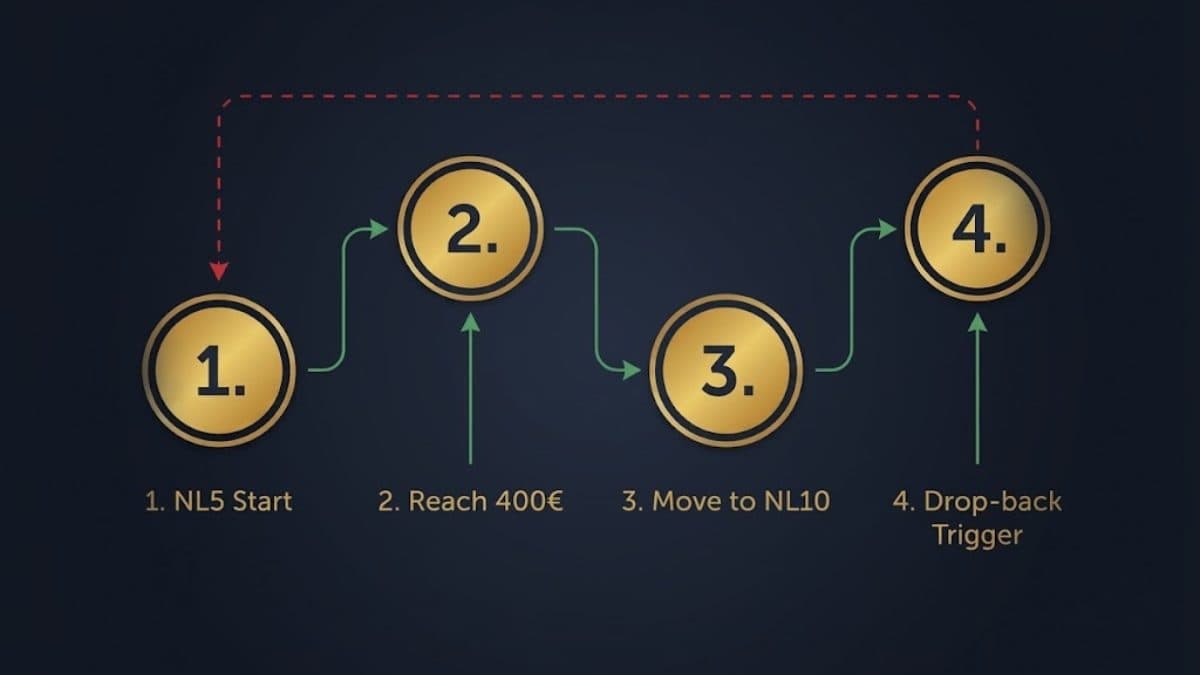
Stake progression rule: when to move up and when to drop down
Moving up too soon is one of poker's most expensive mistakes. Moving up in an orderly way with numerical criteria protects you from moving based on ego or impatience.
Basic Movement Up Rule (Cash)
Move up when you have the minimum bankroll for the next level. Using the 40 buy-in rule: you start at NL5 with $200, grind to $400 (40 buy-ins of NL10) and move up. If your bankroll drops back under $200, you return to NL5.
This prevents two problems: moving up too soon and burning your bankroll at a level where you don't have an edge, or staying stuck out of fear.
Additional Rule: Prove It with Volume
Don't move up just because you hit the number. You should have played at least 15,000-20,000 hands at your current stake with a positive winrate before moving. If your profit graph is flat or declining, fix your game first; moving up will just make you lose faster.
When to Move Up in Tournaments
In MTT there's no clear progression like in cash. The rule is more flexible:
- •Keep your average buy-in within 1-2% of your total bankroll
- •As your bankroll grows, add higher buy-in tournaments to your mix
- •If your bankroll shrinks, reduce your average buy-in or cut the most expensive tournaments
Example: with a $2,000€ bankroll, your maximum buy-in should be $20-40. Moving to $3,000, you can add tournaments of $30-60 without risking your bankroll.
When to Drop in Stakes (Loss Control)
Dropping down isn't a failure. It's part of professional management.
Numerical rule: if your bankroll falls below the safety minimum of your current stake (less than 25-30 buy-ins), drop immediately.
Example: you're playing NL25 with $1,250 (50 BI), run bad and drop to $900. You now have 36 buy-ins of NL25 (still in conservative range) but less than 40 BI of NL10. Many conservative players would drop to NL10 now to avoid exposing their bankroll at a level where another downswing could put them at risk.
Psychological rule: if the downswing affects you mentally and you're no longer playing your A-game (tilt, fear of betting, incorrect folds), drop before even hitting the numerical limit.
Warning: Dropping stakes quickly when a downswing starts is the difference between a player who survives 10 years and one who disappears in 6 months.
Per-Session Risk Rule: No More Than 5%
Beyond total buy-in rules, many players use a daily or per-session risk rule:
- •Don't risk more than 5% of your bankroll in a single cash session
- •Don't spend more than 1-2% of your bankroll on a single tournament
With a $1,000 bankroll: maximum $50 loss per cash session, and maximum $10-20 buy-in per tournament.
This protects against catastrophic sessions: if you lose 5 buy-ins in a row due to tilt, tough tables, or extreme bad luck, it forces you to stop before that session destroys a significant portion of your bankroll.
Conservative players lower the rule to 2-3% per session. More aggressive players with very high edge can go to 10%, but it's not recommended if you're starting out.
Factors That Change How Much Bankroll You Need
The figures in this article are guidelines. These factors change the number of buy-ins you need:
1. Format variance: MTT turbos and hyper-turbos require more buy-ins; cash full ring and deepstack tournaments need less; Spins with extreme multipliers need 200-300 BI.
2. Tournament field size: bigger fields = more variance. A 200-player tournament has much less variance than 5,000; if you play large fields (500+), use the higher range (150-200 BI).
3. Your edge (skill advantage): with a 5+ bb/100 winrate in cash or 10%+ ROI in MTT with a large sample, you can play with slightly less bankroll because your ruin probability is lower. If you're new, you need more bankroll to survive variance while learning.
4. Economic dependence on poker: if you play for fun with a monthly budget, you can be more flexible. If poker is your income, manage your bankroll like business capital: conservative ranges (50 BI in cash, 150-200 in MTT) and strict rules for moving up/down.
5. Multi-tabling: if you play many tables at once, your variance per hour is lower and some grinders playing 8-12 tables can use slightly smaller bankrolls (20-25 BI in cash). If you play 1-2 tables, use conservative ranges.
For more on managing multiple tables without hurting your game, see our complete guide to multi-tabling.
Common Bankroll Management Mistakes
1. Mixing bankroll with personal money. Using rent money to "recover" after a bad session creates psychological pressure and tilt. Solution: open a separate account or wallet just for poker.
2. Moving up based on ego. Winning 10 straight buy-ins at NL10 doesn't mean you're ready for NL25; without enough bankroll at the new level, you can lose everything you won in 3 sessions. Move up only when you have the minimum bankroll AND a proven winrate with volume (15k-20k hands).
3. Not dropping when you should. Defending ego by playing NL50 with insufficient bankroll burns what's left. Drop as soon as your bankroll falls below the minimum; it's temporary, and if you're a winner you'll move back up.
4. Ignoring the 1-2% rule in tournaments. Playing a $100 buy-in Sunday Million with only $500 bankroll "because it's special" exposes you to losing 20% of your bankroll in one tournament. If you want to play expensive one-off tournaments, play satellites or use extra budget outside your poker bankroll.
5. Trusting lucky streaks. Going from $200 to $700 in two weeks might be positive variance, not skill. If you move up several levels without real edge, variance will give it back quickly. Progress gradually and review your play with tracking software before moving up.
Separate Bankroll: Why It's Non-Negotiable
Keeping your bankroll physically separate from your personal finances is non-optional if you play seriously:
- •Mental clarity: you know exactly how much you have to play and when to drop, without self-deception by mixing accounts.
- •Protection from financial tilt: if you mix everything, a downswing can prevent you from paying bills, and that pressure makes you play worse and lose more.
- •Real tracking: separating your bankroll forces honest accounting about whether you're a winner or loser.
How to do it: use a separate digital wallet (Skrill, Neteller, Revolut) just for poker. If you withdraw for personal expenses, treat it as a "profit withdrawal" and adjust your stake to the new balance; if you reload with personal money, consider it a new initial deposit and recalculate the stake.
In Spain, where DGOJ-licensed rooms like PartyPoker.es require payment methods in your name, use an account you can dedicate mainly to poker for easier tracking.
Rakeback and AI Points as Cushion (Not as BRM Substitute)
Rakeback (the room's rake rebate) is paid by the room; the AI Points program works separately and depends on PokerDealsAI. Both help smooth downswings, but neither replaces proper bankroll management.
Example: at BetKings, the Ocean Rewards program can return up to 40-50% effective rakeback. If you generate $200 of rake per month and receive $100, that money reduces your real cost of play and accelerates your bankroll growth.
But if you play a stake you don't have enough bankroll for, rakeback won't prevent ruin: variance can make you lose 10-20 buy-ins in a week and rakeback might return 1-2. It helps, but doesn't rescue poor BRM.
When you register through PokerDealsAI at selected rooms, you accumulate AI Points from your activity, independent of the room's rakeback, which you can redeem or withdraw as a bonus-never as a lifeline against bad bankroll management.
For more detail, check our complete rakeback guide and the article on AI Points accumulation.
Conservative vs Aggressive Strategy
There are two main approaches among regulars:
Conservative: 40-50 BI in cash, 150-200 BI in MTT. Very low ruin risk and less psychological pressure, in exchange for slower progression. Ideal for those dependent on poker income, new players, or low risk-tolerance profiles.
Aggressive: 20-25 BI in cash, 60-80 BI in MTT. Faster bankroll growth if you run well and reach high stakes sooner, but higher bankruptcy probability in a normal downswing. Ideal for regulars with very positive proven winrate or external income allowing reload if needed.
Pro tip: If you're unsure, start conservative. You can always become more aggressive with more experience and winrate data; the reverse path (start aggressive and go broke) costs much more.
How Much Bankroll Do I Need: How Much Money to Start in 2026
How much poker bankroll do you need depends on your goal:
- •Test without commitment: deposit $50-100 and play NL2 or NL5 at international rooms like CoinPoker or BetKings. With $100 you have 50 buy-ins of NL2, enough to test without ruin risk.
- •Play seriously at DGOJ rooms (Spain): deposit $250-500 and start at NL5 or NL10, since Spanish rooms typically start at those limits.
- •Play tournaments sustainably: deposit $500-$1,000. With $500 you can play $5 average buy-in tournaments (100 BI); with $1,000, $10 average or mix $5-20 buy-ins within the 1-2% rule.
- •Try to make poker your income: you need at least $5,000-$10,000 initial bankroll to play NL50-NL100 cash or $25-50 buy-in tournaments with safety margin, plus a personal cushion of 6-12 months expenses outside your poker bankroll.
For a realistic picture of how much you can earn at each level, check our guide to online poker earnings expectations.
FAQ: Common Bankroll Questions
What do I do if I lose my entire bankroll?
Stop playing and analyze what went wrong: did you play outside your bankroll? Did you have an extreme downswing while playing well? Did you play on tilt? If you decide to reload, use money you can afford to lose and start at the lowest stake possible (NL2, $1-2 tournaments) to rebuild with discipline.
Can I play an expensive one-off tournament if I have enough bankroll for the rest?
Yes, if that tournament is less than 5% of your total bankroll (better 2-3%), it's a one-time thing, and you can accept the loss without tilting after. Some players use a separate monthly budget (e.g., $100) outside their main bankroll for special tournaments.
Is it possible to make poker your income with a small bankroll?
Very difficult. It requires enough bankroll to play stakes where monthly winnings cover your expenses (usually NL50+ cash or $25+ buy-in tournaments), a 6-12 month emergency cushion outside your bankroll, proven winrate with large volume (50k+ hands or 500+ tournaments), and mental strength for long downswings.
With $500 you play NL5-NL10 or $5 tournaments, and expected winnings ($100-300/month with heavy volume) don't cover living expenses in most European countries. Realistic range to try poker professionally in 2026: $10,000+ bankroll and low monthly expenses (under $1,500/month). Below that, treat it as supplementary income.
For more on security and fund protection across different rooms, check our guide to trusted networks.
Does rakeback count toward my bankroll?
No. Rakeback is expected future income, not money you already have. Don't count it in your current bankroll calculation: add it when you receive it and recalculate whether you can move up. It speeds your bankroll growth but doesn't change how many buy-ins you need for each level.
Should I have separate bankrolls for cash and tournaments?
Ideal if you play both formats regularly: variance differs between them, lets you calculate ROI better for each, and prevents a downswing in one from hurting the other. For example, with $2,000 total you could allocate $1,200 to cash and $800 to tournaments, so a downswing in one doesn't force you to drop in both. If you only play one format, no need to separate.
Start Building Your Bankroll with Discipline
Bankroll management isn't glamorous. There are no shortcuts: it's simple math and discipline. Play stakes your bankroll can support, move up when you have the bankroll and winrate for it, drop when variance hits.
Long-term winning players aren't necessarily the most talented. They're the ones who manage money with clear rules, don't play on ego, and survive long enough for their edge to show up.
If you're starting out, pick a room with good rakeback and stake structure that lets you progress gradually. Registering through PokerDealsAI gives you access to verified conditions and points for your play volume, which can speed progression, but rakeback helps-it doesn't replace proper bankroll management.
Choose your room and start with a clear plan:
- •CoinPoker: micro-stakes from NL2, daily rakeback, ideal for small bankrolls (from $50)
- •BetKings: Ocean Rewards with up to 50% effective rakeback, GGNetwork, wide tournament variety
- •PartyPoker.es: DGOJ-regulated room, structured VIP program, steady traffic during European hours
Define your bankroll, pick your starting stake from this article's table, and start playing with discipline. Variance will hit you, but with proper bankroll management, you'll still be playing when others have already gone broke.